Risk: What does it really mean, and how much should you take?
Risk in Everyday Life vs. Investing
Think about the fun, non-financial things you enjoy—fishing, mountain biking, or even crossing the road. Each carries a chance of disaster: a shark attack, a crash, or a rogue bus. Yet, if the odds of total loss are low, we shrug it off—the enjoyment outweighs the danger. Investing, however, feels different. Textbooks, regulators, and advisers like me endlessly repeat: ‘some investments carry higher risk than others’. Why the emphasis on the negative like an erection medication commercial?
No one wants to be blamed if you lose money. The backside-covering of risk ‘disclosures’ shifts the focus to side effects rather than the cure, ironically nudging some investors to treat investing like a game of chance instead of a disciplined, long-term pursuit.
The Risk-Return Connection
But, why take any risk at all? Simple: no one invests to lose money—we all want gains. The catch? Risk and returns are positively correlated. To grow your wealth, you must accept uncertainty around how well you’ll perform. In a perfect world, we’d save for our retirement, and not take any uncertainty at all. Unfortunately the things you want to spend money on later, are all more expensive by the time we need them. We have to get more comfortable with risk if we want to have a retirement of abundance.
So does cranking up the risk guarantee better returns? Not quite. Too much risk turns you into a gambler, not an investor—and the longer you gamble, the more certain loss becomes. On the flip side, avoiding risk entirely by parking your money in cash isn’t the answer either. Cash loses about 3% of its purchasing power annually to inflation—We’re stuck choosing our vice: casino or a melting ice cube.
Risk Isn’t Volatility
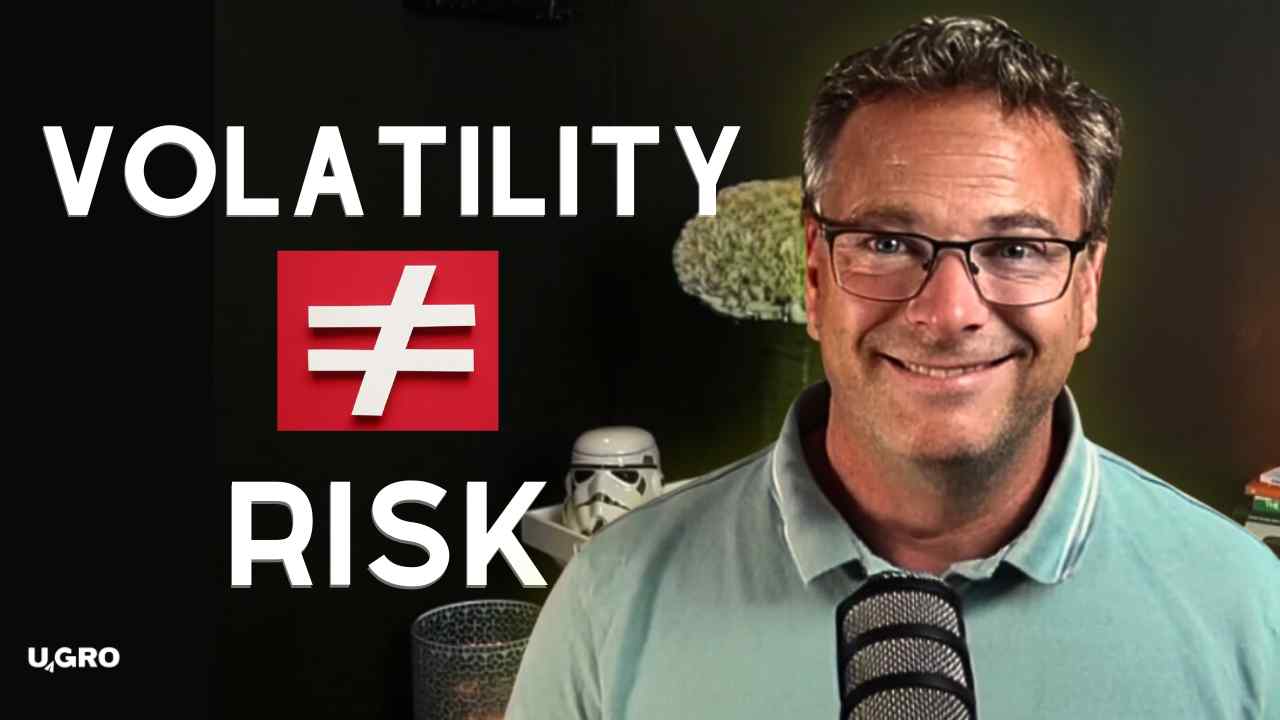
This is the most tragic communication blunder the investment industry (including regulators) have committed. Risk is not the same thing as volatility. Disclosure documents use the term “risk” when they actually mean volatility. It’s understandable too – after all, how else do you effectively communicate complex financial concepts the broadest range of people? (hint: you can’t)
Volatility is the word that describes how prices fluctuate over time.Risk is the probability of financial loss.
These are not interchangeable terms.
Take a rental property bought for $500,000 a decade ago. Last year, it hit $1 million; now it’s $800,000. Risky? Or just an asset that changes price? Or consider Apple shares in 2007, pre-iPhone. They doubled in a year—a 100% swing. Volatile? Absolutely. Risky enough to lose it all? Not really.
Volatility gets a bad rap, but it’s not inherently negative. Some of the best returns—like Bitcoin’s meteoric rise—come with wild price swings. Bitcoin’s real risk isn’t its volatility; it’s losing your wallet if you don’t secure it properly. The asset isn’t the problem—the hands holding it are.
For investors operating under a strategy who hold ‘conviction’, or the unwavering belief in their investment thesis, big price drops are buying opportunities. Volatility is a natural byproduct of high performance—it only becomes “risky” if it spooks you into selling at a loss.
When Low Volatility Can Actually Be Bad
High volatility doesn’t always mean high risk, but low volatility can sometimes spell trouble. Picture a failing company’s stock: its price drifts downward, flatlines, then vanishes. Before it dies, it barely moves—low volatility masking a death spiral. I’ve invested in a few of these (for “education,” not FOMO ;)), watching months of stagnation end in nothing. If “low-risk” means no price swings, I’d have picked these disasters every time.
Two Investor Mindsets
The volatility-risk confusion causes us to migrate to one of these two investor types.
-
Risk-Averse Gamblers: Scared of risk, they’re ironically the most easily influenced by FOMO. When short-term bets fail, they sell at peak fear. The risk here isn’t the investment—it’s their lack of strategy.
-
Volatility-Embracing Builders: Armed with conviction and research, they see price drops as chances to buy more. They’re optimistic, informed, and unfazed by uncertainty because they believe in the long-term future.
Four Real Risks to Watch
So, if risk isn’t volatility, what is it? Here are four genuine risks to consider:
-
Bad Investments: Social media buzz isn’t a substitute for fundamentals but even when we’ve done a bit of work, it’s still possible to pick a dud. While we may be able to hold on until it recovers (if it does), our real loss is the returns we couldn’t get elsewere.
-
Macro Events: Central bank policies, trade wars, or societal shifts can tank an otherwise solid investment’s environment. Stay aware without getting bogged down.
-
Systemic Risk: Most assets are tied to fiat currencies, which fail surprisingly often—175 in fact, since 1900, with an average lifespan of 35 years. Hedge with alternative forms of money like physical precious metals or Bitcoin in your own wallet.
-
Volatility as Risk: Yes, volatility can bite—if you panic and sell at a loss. A 70% market drop, an unexpected cash need, or apocalyptic headlines can test anyone. It’s not ‘market risk’; it’s your reaction to to the market.
Managing Risk and Embracing Volatility
The good news? You can reduce the above risks with strategy that has conviction (Not the type that you can magic up, but the type that comes after hours of research and genuine interest). If you’ve done your homework and invest long-term, volatility becomes your ally, not your enemy.
Watch now
How I Gauge My Risk (Volatility) Tolerance: Here’s how I personally decide how much volatility I can handle:
-
Effort Level: Am I genuinely willing to put in the time learning? If not, I use managed funds to tap into expertise and compounding returns without overcommitting my time.
-
Conviction Check: Do I hope the price rises, or do I know it will? Times of testing will come – will you make it through?
-
Investing or Gambling: Am I betting on short-term cycles or fixating on loss more than testing our conviction?
How much risk is right for you?
Of course it’s personal, and it depends on your age, your mental set up, and what stage you’re currently in. We should be concerned about the risk of financial loss, like bad picks or systemic shocks, but when it comes to volatility, it’s all about you. How much time and effort will it take to get an ‘above-average’ return, and are you really able to give it? Are you genuinely developing a high conviction to adopt a concentrated investment strategy, or are you being influenced too much by others? Are you really investing for the long-term, or will you sell up and take profits once you think we’ve hit the peak? High-volatility investments can deliver stellar returns if you’re in it for the long haul and unshaken by uncertainty.
When risk isn’t volatility, the risk/return curve ‘breaks’ – higher returns can occur* without increasing the chance of financial loss.
*And now, to be consistent with mainstream financial advice, which is a highly regulated space… remember that past returns are not a promise of future returns. Remember also that some volatile investments can be symptomatic of fads and investments scams. This article is opinion only and may constitute terrible financial advice if followed.