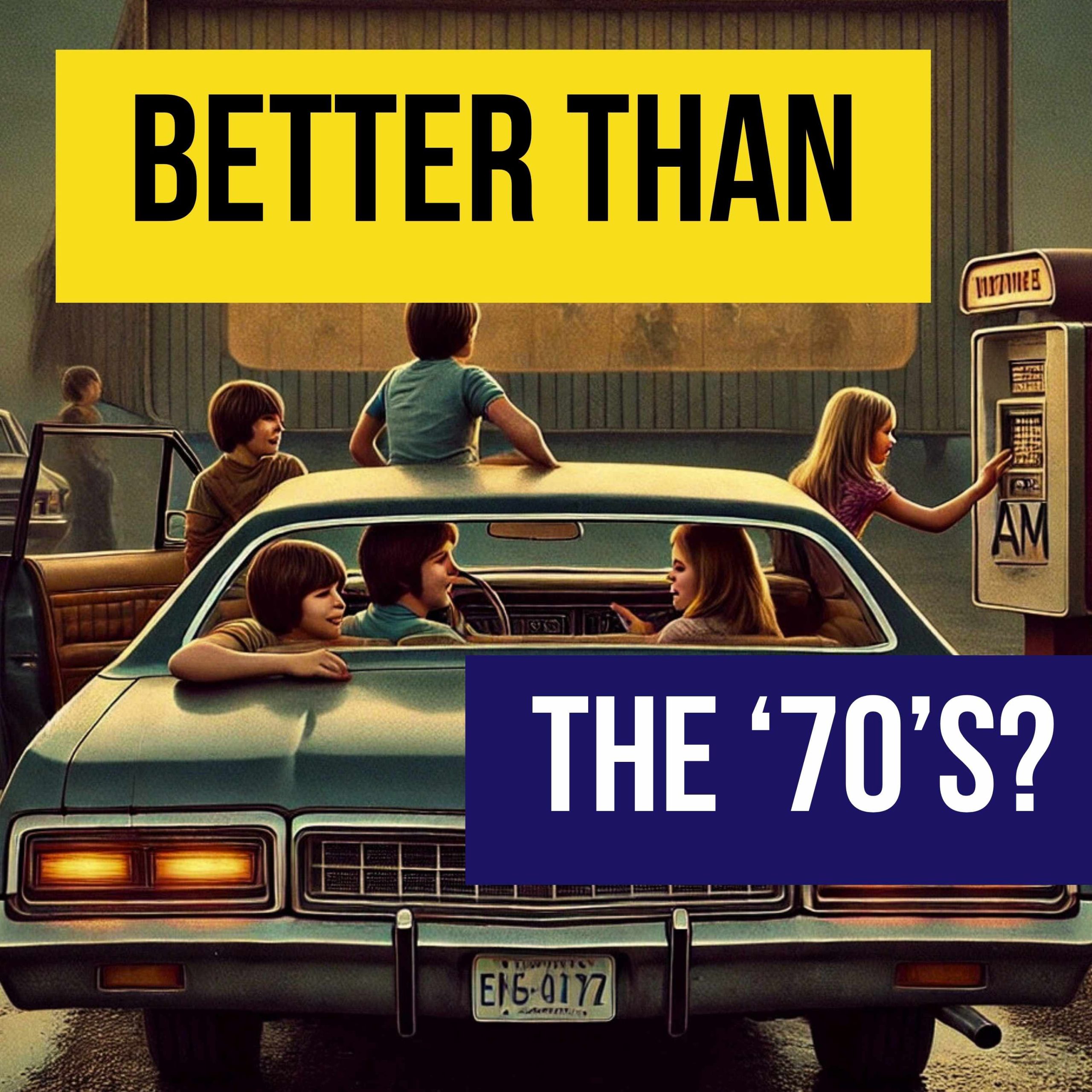
I have kids, so I’ve watched “Guardians of the Galaxy” a hundred times. The soundtrack features the late 60s and early 70s family supergroup, The Five Stairsteps. Their song “O-o-h Child” would have been known to us growing up back then, distorted, of course, by the 1970s family sedan AM radios.
It’s an effective tactic Hollywood uses: leap into the next generation by reviving all the hits our parents loved when we were kids. Same soup, different spoon. Hearing these songs makes me think about the older generation, their experiences, the shifts in perspectives, economic or political uncertainty, and worrying conflicts in faraway places.
Apart from the fact that the music was arguably better back then, many problems from the early 70s are playing out again today, especially inflation. We rely on something called the CPI, or consumer price index, for example. It tells us the inflation rate. We ought to think critically here around the CPI, because for one thing, it can’t capture the try cost of living if it doesn’t include mortgage payments.
In any event, the CPI reveals something about our currency’s ‘purchasing power’. It’s blatant theft according to some and for others, it’s a legitimate ‘cost of building an economy.’ Like most developed countries, our New Zealand dollar will consistently buy less stuff over time, yet never fail as a currency (yet). Inflation describes the speed at which prices rise, and it’s only an issue when you don’t have assets or are on a fixed income. As long as we’re earning more income each year, we tolerate inflation just fine. To really understand how bad inflation is today, compared to 50 years ago. We should look at inflation in the early 70’s. In the first four years from ’70 to ’74, the cumulative rate of inflation was almost 40%. $1 in 1970 would end up buying only $0.60 worth of goods in 1974.
We ought to think critically here around the CPI because for one thing, it can’t capture the true cost of living if it doesn’t include mortgage payments. Technology makes our lives better in ways that need to be factored in also, but it’s getting harder to ‘un-see’ the damage that inflation causes. It feels like we need to trade more of our time and energy than our parents did, for the same kind of life. More, everyday people are starting to get smart as to where it all comes from too. For some, including myself, we need to ‘unlearn’ some of what we learnt growing up about inflation.
My kid was taught recently in school that inflation is caused when businesses charge more for their products and services they produce, (because, you know, greedy capitalists), so workers (you and me) ask for a pay rise. With more money in their pockets, us greedy consumers go out and spend it, causing businesses to price gouge from the higher demand. This surely isn’t an accurate picture of what’s taught in schools, but it’s close. Later on, perhaps in uni now, kids will learn about ‘cost-push’ and ‘wage-pull’ inflation models.
Meanwhile in real life, a growing cohort believe this: When interest rates are cheap, assets get expensive first, and then later on, food, insurance, and everything we need rises in price too. Looking further up the chain, beyond the businesses, and to the banks, the regulators and the government. Thanks in part to podcasts and YouTube channels we can now access for free, there’s a growing perspective that the ‘money’s broken’. It’s governments and it’s central banks through complicated shell games, that dilute and ‘debase’ our currency to achieve their ambitions without having to pass the hat around. There’s only so much they can do to help businesses make more money, so the rate of tax collected is somewhat finite. How do you fund a hungrier state then? Through the monetary system.
So back to today. It shouldn’t cost a day’s worth of pay to take the kids out to the movies.
It shouldn’t require both parents at work.
We shouldn’t have to use debt to get ahead.
I think back to that AM radio playing in the family car: “O-o-h Child, Things are gonna get easier…”. The Five Stairsteps said ‘things are gonna get easier, brighter, and we’ll get it together’…it’s quite an uplifting song, really. They were either lying about the future though, or they didn’t know about inflation.
When did it all start?
Back-room brokered deals ensuring oil profits of the Middle East funded US growth through the treasury markets in the early 70’s, eventually lowered the cost of borrowing, and the price of energy, in one move. American exorbitant privilege (after a decade-long battle with inflation), spread throughout much of the developed world. From early 1980’s on we saw the best 40-year period ever to own property and have debt. Each debt cycle would lead interest rates to lower highs and lower lows with. Meanwhile, property and share markets began to double in price over 7-10 year timeframes. Wealth began to accumulate for those who either understood what was going on, or who instinctively knew how to take advantage of a good situation. Mimicry and progressivism are comfy bedfellows. The currency-creation credit cycles spawned pyramid schemes out of almost any asset borrowed ‘money’ could buy. A large portion of what most of us call ‘wealth’, was created this way.
Inflation is relatively easy to hide as long as every 50years there’s another person from the household going to work. It’s a convenient thing, that in the 70’s, we’d witness women entering the workforce. Inflation made it necessary for both parents to work. What about the kids? Don’t worry, the government teach them everything they need to know. With any luck they’ll grow up to become ‘Modern Monetary Theorists’.
But let’s get back to the question: Is inflation worse now than 50 years ago?
Let’s consider the last 4 years.
$1 in 2020 is now worth around $0.83 in 2024. Compared to the $0.60 in 1974, maybe it’s not so bad?
Sure, we’d probably all appreciate the lower prices of the early 70’s, but not without Wifi.
We’d love the classic cars we could fix ourselves, but not their outdated performance.
We’d love to let our kids watch TV unsupervised and play outside…
It’s helpful occasionally, to reminisce about memories we don’t have.
Seeing these other perspectives can help us feel thankful, instead of downtrodden. All things considered, I’m struggling to see how things are worse today than they were back then. Perhaps it doesn’t matter. Repeating and rhyming history forces the world to confront and conquer before we get to the next level. I think money is one of these things.
For some reason, humanity collectively struggles to learn that when you mess with the money, you mess with your empire (refer to the Romans). When we abandon monetary reference points like gold for our monetary base and God for values and rule of law, we drift and become weak. Eventually, ‘real life’ catches up and forces us to deal with the consequences. It’s hard to say this day is coming anytime soon so here’s the challenge: Knowing that inflation’s here to stay, you should start defending yourself from it.
How to defend yourself?
- Spend less than you earn.
- Invest the difference, the best you can.